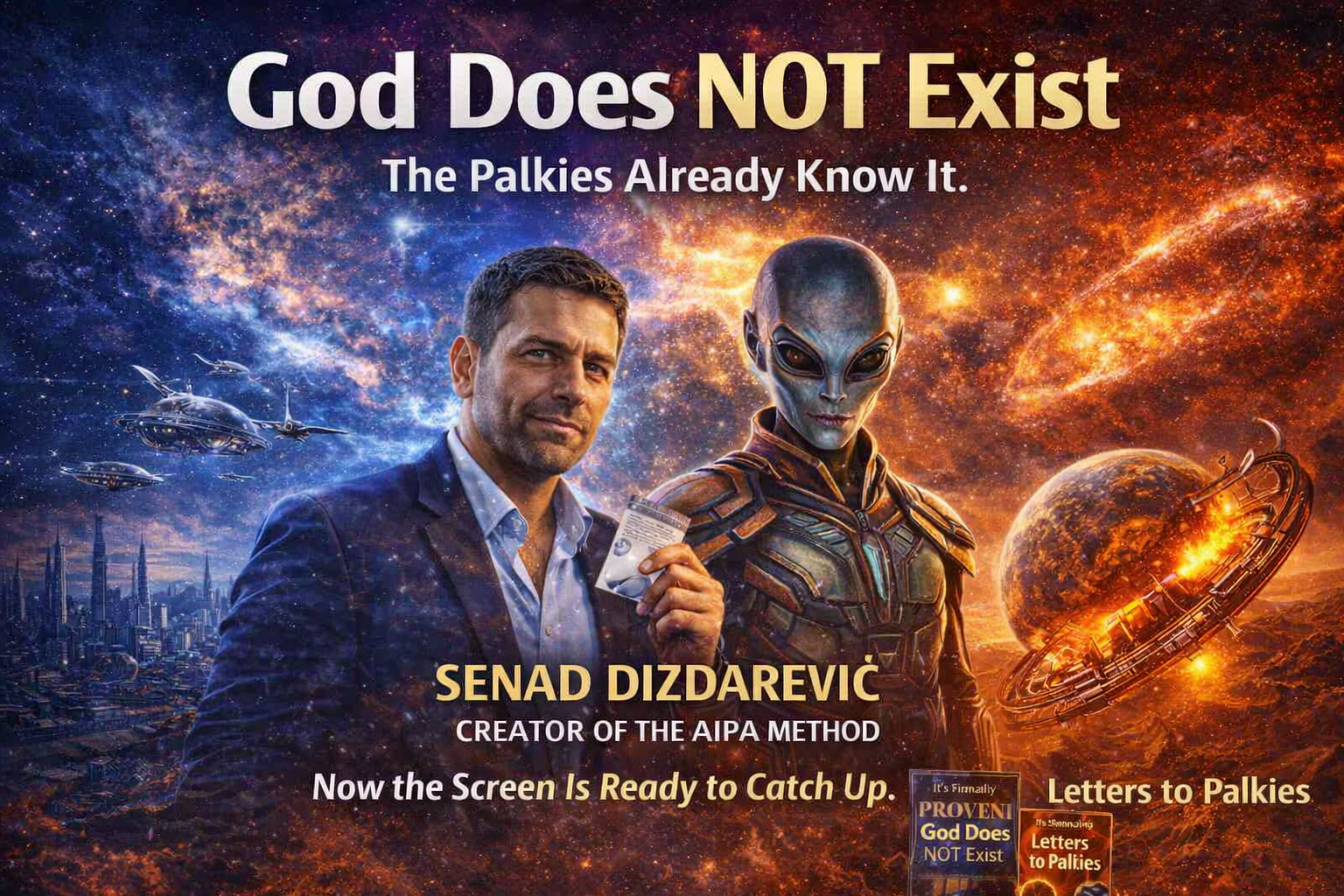
God Does NOT Exist. The Palkies Already Know It.

Now the Screen Is Ready to Catch Up.
Senad Dizdarević — creator of the AIPA Method and author of It’s Finally PROVEN! God Does NOT Exist and Letters to Palkies — is making two fully built cinematic universes available for option, adaptation, and co‑production.
A press release for film and television producers — April 2026
Two book series. Twelve volumes. One Slovenian journalist who dismantled an entire religion with logic — while maintaining direct, real‑time contact with the inhabitants of another planet. This is not a logline for a speculative screenplay. This is a universe that already exists, with hundreds of published texts, an international readership, and narrative stakes that make most conventional IP packages look small.
Based in Ljubljana, Senad Dizdarević is a journalist, award‑winning author, and creator of the AIPA Method (Awakening Into Pure Awareness). His two flagship platforms — god-doesntexist.com and letterstopalkies.com — function as twin pillars of an interconnected philosophical and narrative world that is unusually ready for screen translation. The cosmology is in place. The characters are alive. The arcs are complete. What is missing is the camera.
Book Series I: It’s Finally PROVEN! God Does NOT Exist
Four‑volume series · Available on Amazon · god-doesntexist.com
Genres: Thriller / Suspense · Biopic / True Story · Dark Comedy · Faith Crime
Across four volumes, Dizdarević lays out what he presents as the first coherent, multi‑layered evidence in human history that God does not — and cannot — exist, arguing on scientific, logical, ontological, and experiential levels. The material reads not like abstract theology, but like an intellectual thriller: one man systematically disassembles the most entrenched institution on Earth — organized religion — and walks away freer.
For screen storytellers, the cinematic hook is immediate. The protagonist is not a prophet or a preacher but a working journalist whose central claim is that his position is provable, not merely opinion. At its core, this is a story about a person who sees through a system that almost everyone else still inhabits — and must choose how far he is willing to go with that knowledge.
What kind of film or series is this?
The series lends itself to several proven formats:
- Feature film — A tightly constructed intellectual thriller, a philosophical counterpart to whistleblower dramas or “system crash” stories, with the antagonist not a corporation but a millennia‑old belief structure.
- Limited series (4 episodes) — Each volume, and each mode of evidence (scientific, logical, ontological, experiential), can anchor an episode, creating a layered character study and escalating confrontation with institutional faith.
- Dark comedy — One man in Ljubljana calmly assembling proofs against God while global religious systems continue as usual has a distinctly Kafka‑esque absurdity. Being right in a world that refuses to notice is one of cinema’s most durable tensions.
Feature outline
Senad, a Slovenian journalist living in Ljubljana, constructs what he believes is the first logically airtight, scientifically grounded, ontologically complete proof that God does not exist — and never could. He publishes. Institutions ignore him. Believers carry on. Yet the emails start arriving: atheists who finally feel that their stance is not just an opinion; believers who were waiting for permission to lay down their faith; former religious devotees whose entire identity is dissolving and who urgently need a new frame for reality. The film cuts between Senad’s internal journey — a man holding a proof the world refuses to see — and the lives of his readers as the architecture of a centuries‑old lie collapses, proof by proof, volume by volume.
Potential titles
- It’s Finally PROVEN
- God Does NOT Exist
- The First Valid Evidence
- The Ljubljana Proof
- No God, No Guilt
- The Last Religion
- After God
Casting ideas
- Oscar Isaac — Senad Dizdarević, the journalist‑philosopher carrying an impossible proof in a world not yet ready for it
- Cate Blanchett — A senior Vatican theologian tasked with dismantling Senad’s work, who begins to be persuaded by it
- Antonio Banderas — A former Catholic priest in ethical freefall, one of Senad’s earliest readers, whose unraveling becomes the emotional backbone
- Tilda Swinton — A brilliant but emotionally distant AI researcher who independently reaches Senad’s conclusions via computational theology — and reaches out
- Pedro Pascal — Senad’s closest friend and skeptic, a fellow journalist who demands rigorous justification for every claim and whose eventual conversion marks the story’s pivot
Recommended screen formats
- Feature film (thriller/biopic): Single‑protagonist journey of intellectual revolt and personal emancipation, built for theatrical play.
- Limited series (4 episodes): One volume per episode, culminating in a comprehensive unmasking of religious institutions.
- Documentary hybrid: Dizdarević’s real‑world trajectory — from journalist to cosmic philosopher — is a true story with global relevance.
Tonal and thematic neighbors
- Inherit the Wind — Courtroom drama of ideas; an individual vs. institutional religion
- The Big Short — Someone sees the truth early; no one listens; the world changes anyway
- Contact (Zemeckis) — Science and faith as genuine opposing forces, not caricatures
- Doubt (Shanley) — A clear‑eyed look at institutional religion as lived human drama
Book Series II: Letters to Palkies
Four‑volume series · Available on Amazon · letterstopalkies.com
Genres: Science Fiction · Action · Thriller / Suspense · Family · Interplanetary Drama
Letters to Palkies is a category breaker: a first‑person, multi‑volume account of interplanetary contact, interdimensional love, cosmic insurrection, and planetary liberation — presented as the author’s lived experience rather than invented fiction. Planet Palki occupies the same physical coordinates as Earth in space, but in a parallel dimension. Its inhabitants, the Palkies, live under a predatory karmic regime called the Karmicons, as do Earthlings. The crucial difference: the Palkies know it.
For years, Senad communicated directly with Sanja — his partner on Palki — in real time, planet to planet, until a planetary blockade cut off direct contact. He now continues to reach Sanja, the Palkies, and other planetary civilizations through lucid dreaming. With Sanja, her mother Katerina, their interplanetary team, and an alliance of sixth‑dimensional space civilizations, they have already dismantled the Karmicon hierarchy on Palki — restoring bodies, reviving the dead, redistributing wealth, and rewriting the planetary constitution. The next phase is Earth.
What kind of film or series is this?
In terms of scope, concept, and built‑in franchise runway, Letters to Palkies is a natural foundation for long‑form storytelling:
- It is an intimate love story across dimensions.
- It is an action‑driven resistance saga against a cosmic control architecture.
- It is a sweeping mythology, populated by billions of beings, historical figures, and energy‑based allies operating across dimensions.
For long‑form television, this is a multi‑season property. Each season maps cleanly onto a volume: from first contact and the liberation of Palki, through the breakdown of the Karmicon system, to the opening stages of Earth’s own liberation. As a feature or trilogy, the inciting dramatic question is simple and high‑concept: a man in Ljubljana is in real contact with another planet and has already helped free it — what happens when he turns that capacity toward Earth?
Feature outline
Senad, a Slovenian journalist, maintains a cross‑dimensional relationship with Sanja, a woman living on Planet Palki, a world overlaying Earth in a parallel dimension. With Sanja, her mother Katerina, and an interplanetary resistance network, he helps orchestrate Palki’s liberation from the Karmicons — a hidden control grid that keeps its citizens imprisoned and oblivious to their true nature as Beings of Pure Awareness. The operation succeeds: a billion Palkies receive new bodies, homes, partners, and freedom. Then a planetary blockade cuts direct communication. Now, Senad reaches Sanja and their allies only through lucid dreams, and together — between sleep and waking — they begin designing the liberation of Earth. The resulting film can be staged simultaneously as a love story, a resistance thriller, and an origin myth: one man’s dream life is more consequential than anyone’s waking life, and an entire planet’s future depends on his ability to stay asleep just long enough.
Potential titles
- Letters to Palkies
- Planet Palki
- The Karmicon War
- From Planet to Planet
- Sanja
- The Lucid Ambassador
- After the Blockade
- Liberation: Earth
Casting ideas
- Viggo Mortensen — Senad Dizdarević, a man whose inner universe far exceeds what anyone around him can see
- Eva Green — Sanja, Senad’s partner on Palki; fierce, incisive, and the strategic architect of liberation
- Isabelle Huppert — Katerina, Sanja’s mother and co‑author of the new planetary order; the moral anchor of the saga
- Idris Elba — Leader of the sixth‑dimensional Selini allies, operating with calm precision on timescales far beyond human comprehension
- Léa Seydoux — Emi, a Palki intelligence operative who appears to Senad in lucid dreams with mission‑critical data
- Daniel Craig — Black Cloud, the enigmatic gatekeeper blocking the space allies from fully engaging with Earth; both antagonist and reluctant catalyst
Recommended screen formats
- Prestige TV series (multi‑season): The natural format. Season 1: contact and Palki’s liberation. Season 2: the first campaign on Earth.
- Feature film trilogy: A three‑act meta‑story from awakening, through interplanetary action, to the turning of Earth’s timeline, comparable in ambition to The Matrix.
- Animated series: The two-dimensional geography of Palki, its energy beings, and cosmic infrastructure, would translate powerfully to animation for a broad audience.
Tonal and thematic neighbors
- The Matrix — Hidden systems of control and liberation via awakening and organized resistance
- Arrival — Contact as an intimate, transformative experience rather than a spectacle alone
- Dark (Netflix) — Parallel realities and karmic cycles as engines for drama
- Cloud Atlas — Consciousness and connection across time, space, and incarnations
About the Author and Platforms
Senad Dizdarević is a Slovenian journalist, award‑winning author, and personal development specialist. He holds a Bachelor’s degree in Journalism and has written twelve books covering atheism, cosmic philosophy, faith deconstruction, lucid dreaming, and the AIPA Method. His work has appeared in Metropolitan and Misteriji magazines and has been recognized by PharmaTech News for its applications to stress management.
His digital ecosystem is anchored in two interconnected sites. God-doesntexist.com is the rational pillar: 80+ articles on atheism, religious deconstruction, and evidence‑based philosophy, plus the complete first book series. Letterstopalkies.com is the experiential pillar: the AIPA Method, the Letters to Palkies series, and 300+ articles on awakening, lucid dreaming, and identity reconstruction beyond religious conditioning.
Taken together, these platforms form a complete narrative and intellectual universe — cosmology, cast, and stakes already fully articulated. For producers, this is rare IP: the world‑building is complete before a single frame is shot.
For film & television producers
Both series are available in eBook and paperback on Amazon, and in eBook format through public library systems. Pitch decks, treatments, and partnership inquiries can be initiated via the platforms below.
Senad Dizdarević is actively seeking co‑production partners, option deals, and development collaborations with producers who recognize that today’s most original IP is not locked inside studio archives, but developed by independent creators who have built their universes without compromise.